It’s important you protect and build your voice by using targeted exercises that increase strength and flexibility in your vocal cords. You will learn simple breathing techniques, gentle warm-ups, and sustained tone practices that reduce strain and improve endurance.
With short daily routines and proper posture, you can sing or speak longer without fatigue and keep your voice reliable for work or performance.
Understanding Vocal Cords
Your vocal cords sit inside the larynx and act like tiny vibrating strings that shape your voice; during normal speech, they can vibrate roughly 100–300 times per second, while higher pitches in singing push that rate even higher.
Damage, swelling, or poor coordination changes your pitch, loudness, and clarity, and repeated strain can lead to nodules or chronic hoarseness that interferes with daily use.
Anatomy of the Vocal Cords
You have five tissue layers in each vocal fold, often grouped as cover, transition, and body: the thin epithelium, the superficial, intermediate, deep lamina propria, and the thyroarytenoid muscle. Adult male vocal folds average 17–25 mm long and females 12.5–17.5 mm, with the superficial layer providing the pliability needed for smooth vibration and pitch control.
Importance of Vocal Cord Health
Your voice quality directly links to your vocal fold condition; hoarseness, breathiness, or loss of range often signal inflammation, nodules, or reflux.
Up to 50% of teachers and high-voice-use professionals report significant voice problems during their careers, and singers can lose performances or contracts when their vocal stamina fails.
Recovery timelines vary: acute laryngitis may improve in days with rest and hydration, while vocal nodules often require 6–8 weeks of voice therapy and technique change, with surgery reserved for persistent lesions.
For example, a choir director who shifted to diaphragmatic support and weekly therapy regained full range after two months of targeted rehab.

Common Vocal Challenges
Hoarseness, pitch breaks, and reduced projection often appear after repeated heavy use; teachers may notice fatigue after just 30–60 minutes, while singers can lose top notes after intensive rehearsals.
You may also face throat tightness, chronic clearing, or sudden range loss following illness or reflux. Many issues trace to inflammation, misuse, or insufficient recovery between sessions, so targeted exercises and pacing become key to lasting improvement.
Identifying Vocal Strain
Listen for persistent roughness, breathiness, or a feeling of effort when you speak or sing; onset after 10–30 minutes of use often signals overload. Pain, a tight throat, or frequent voice breaks during sustained notes are red flags.
If hoarseness lasts longer than 2 weeks despite rest, seek a voice specialist for laryngoscopic assessment to rule out nodules or lesions.
Factors Affecting Vocal Durability
Hydration, technique, and total vocal load strongly determine how long your voice holds up: aim for 1.5–2 liters of water daily and schedule rest if you use your voice more than 4–6 hours a day.
Acid reflux, smoking, antihistamines, allergies, and low humidity degrade mucosal health; age and hormonal shifts also alter pliability and range. Small daily habits compound into major gains or damage.
- Hydration: target 1.5–2 L of water per day and avoid dehydrating drinks before heavy use.
- Technique: diaphragmatic support and forward resonance reduce glottal impact and strain.
- Load management: limit continuous speaking/singing blocks; insert 5–10 minute voice breaks each hour.
- Medical and environmental factors: treat reflux, avoid smoking, and maintain 40–60% humidity.
- Knowing when to rest or seek help—persistent symptoms after 14 days warrant professional evaluation.
Technique and recovery habits can make the biggest difference: semi-occluded vocal tract exercises (lip trills, straw phonation) reduce collision forces by up to 30% in lab measures and are used by singers and clinicians alike.
You should schedule progressive load increases—start with 20–30 minutes of focused practice and add 10% weekly—and use 5–10 minute microbreaks to restore mucosal lubrication. Track symptoms and vocal hours to spot trends before problems escalate.
- Warm-ups: 10–15 minutes of gentle humming and glides before heavy use.
- Recovery: cold-water intake, steam inhalation for 5–10 minutes, and sleep to aid tissue repair.
- Scheduling: cluster intense vocal tasks with recovery days; avoid back-to-back heavy-performance nights.
- Monitoring: keep a log of hours, symptoms, and perceived effort to identify harmful patterns.
- Knowing when to consult an ENT or speech-language pathologist—persistent pain, bleeding, or loss of range requires prompt assessment.

Warm-Up Exercises for Your Voice
Start with 5–10 minutes of gentle movement to get airflow and blood to the larynx: walk in place, shrug shoulders, tilt your head. Do 3–5 diaphragmatic breaths of 4–6 seconds in and 6–8 seconds out while keeping ribs soft.
You should use this routine before practice, rehearsals, or long calls to lower tension and improve breath control.
Breathing Techniques
Practice diaphragmatic breathing: inhale 4–6 seconds through your nose so your belly expands, exhale 6–8 seconds through slightly pursed lips. Do 6 cycles twice daily and place a hand on your abdomen to feel the movement.
Use steady airflow to support vowels for 4–6 counts during phrases to lessen strain on your folds.
Gentle Vocalizations
Begin with lip trills, humming, and gentle sirens across a comfortable range for 5–10 minutes; you should start at mid-range and slide up and down one octave.
Perform 2–3 sets of 5 repetitions, keep volume low and posture aligned. Use these to balance your resonance and warm the folds without pushing sound.
For lip trills, relax your lips and blow steady air so they vibrate; try five-note scales ascending and descending. Hum on “mmm” with a forward facial buzz for 20–30 seconds and repeat 2–4 times to boost resonance.
If you notice throat tightness, lower your volume, narrow the range, and focus on steady breath support to avoid fatigue.
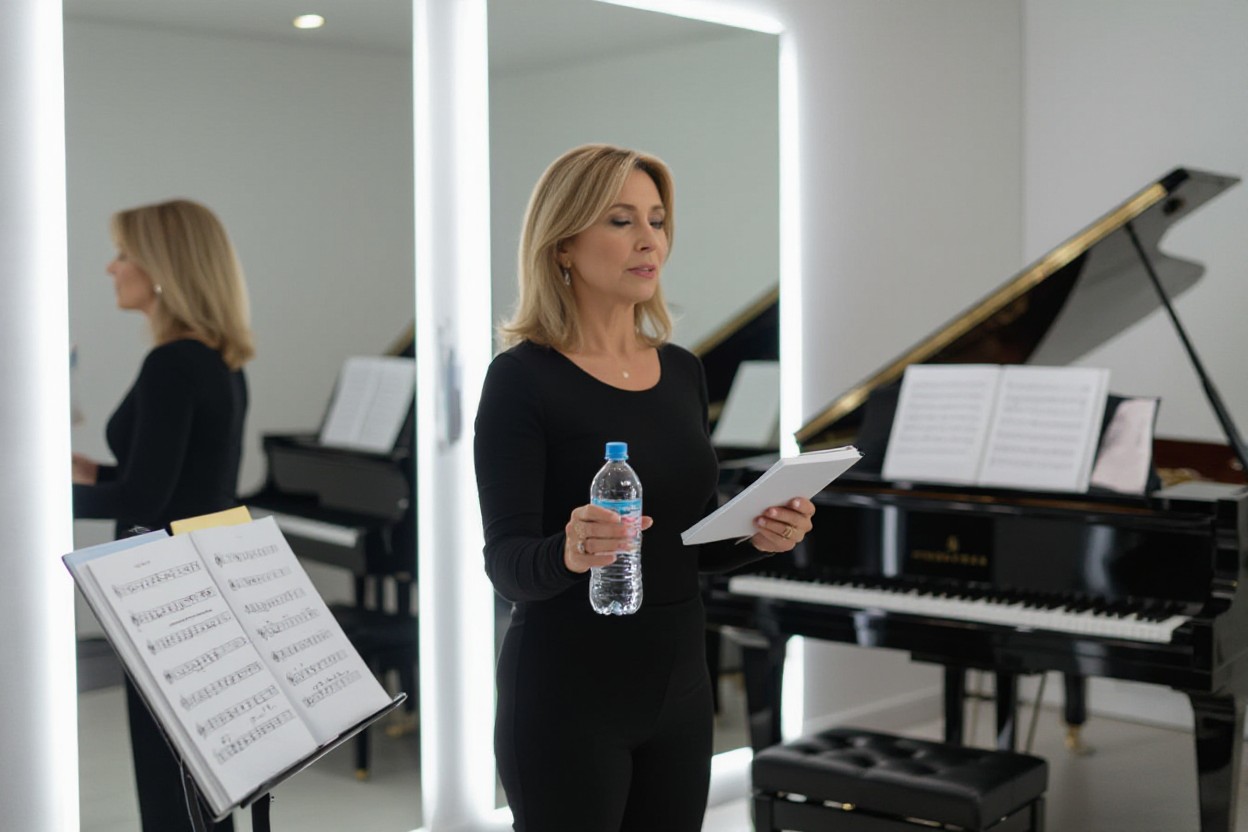
Strengthening Exercises
Aim for daily sessions of 10–15 minutes focused on targeted strength moves: 3 sets of 8–12 lip trills, straw phonation, and short sirens with 30–60 seconds rest between sets. Increase workload by 1–2 minutes per week or add one set every 7–10 days to build stamina.
Track progress by timing how long you can sustain a clear vowel on one breath and try to add 2–3 seconds weekly while staying hydrated and warmed up.
Resonance Building
Try humming on the “ng” sound for 3–5 minutes daily to feel vibrations in your mask and upper lip, aiming for steady resonance without strain. Use straw phonation for 2–3 minutes to focus energy forward and reduce throat tension.
Add chest-voice vowels like “ah” and “oh” in 2 sets of 6 reps to strengthen lower resonance. Record short clips twice weekly and compare tone to hear measurable shifts over two weeks.
Pitch Control Techniques
Use a piano or tuner app to match pitches across a 5-note scale for 2–3 minutes per session, holding each note 2–3 seconds before moving stepwise up and down. Set a metronome to 60 bpm so each pitch lands on one beat, training steady transitions.
Aim to hit pitches within about 10 cents of the reference pitch and log accuracy weekly to track improvement.
Practice sirens that span your full range by sliding from the lowest comfortable note to the highest and back over 6–8 seconds, repeating 4–6 times. Add interval drills: sing major thirds, perfect fourths, and major sixths in 5-rep sets to build precision.
Work chromatic runs of 8–12 notes at 50–70 bpm for agility, and use feedback from a teacher or apps like Vocal Pitch Monitor to adjust technique if notes feel forced.
Maintenance and Care for Your Voice
You should schedule daily warm-ups of 10 minutes focusing on gentle lip trills, sirens, and humming, and give your voice 24–48 hours of reduced use after heavy performance or long rehearsals.
Limit caffeine to one 8‑oz cup and avoid smoking; steam inhalation for 10 minutes can soothe the cords. For structured routines, try the 3 Voice Building Tasks to Strengthen A Weak Voice for progressive loading and tracking.
Hydration and Diet Tips
Drink at least 2 liters of water daily and sip during long sessions; avoid dairy before singing since about 20% of people report increased mucus, and cut alcohol and spicy foods before performance.
Use a humidifier set to 40–60% in dry rooms and eat small, low‑acid snacks before long shows. Any changes you make should be tracked for a week to gauge their effect on your voice.
- Water goal: ~2 L/day (more in hot conditions)
- Humidifier: 40–60% relative humidity
- Avoid dairy and heavily fried foods before singing
- Choose bananas or whole‑grain toast for stable energy
Avoiding Vocal Strain
Anchor your chest and support airflow with diaphragmatic breathing; keep pitches in a comfortable mid‑range during heavy schedules and avoid whispering, which can strain the folds more than soft phonation.
Limit loud talking to under 15 minutes at a time and use a microphone when addressing groups of over 50 people to cut collision forces on the cords.
Use semi‑occluded vocal tract exercises like straw phonation for 5–10 minutes daily; studies show SOVT reduces collision stress and helps coordination.
Schedule silent breaks of 10 minutes every hour during intense use, ice the neck briefly after long days if you feel swelling, and see an ENT or speech‑language pathologist if hoarseness persists beyond 2 weeks.
Incorporating Vocal Exercises into Daily Routine
Weave short sessions into daily life: 3–4 micro-practices of 5–10 minutes (morning, midday, pre-performance) plus one focused 30–45 minute session weekly. Prioritize warm-ups, resonance drills, and stamina work so you hit 80% of exercises each week. Use alarms, a practice bag with a notebook, and a piano app to keep each slot consistent.
Setting a Practice Schedule
Block 15–30 minutes in your day, five times a week, splitting time: 5-minute warm-up, 10 minutes breath/resonance, 10 minutes pitch/articulation, and 5 minutes cool-down.
Schedule a longer 45–60 minute session once weekly for endurance drills like sustained phrases and dynamic control. Use calendar alerts and treat sessions like appointments so you don’t skip them.
Tracking Progress
Log three numbers each practice: maximum comfortable range in semitones, longest steady exhale (seconds), and perceived effort on a 1–10 scale. Check range with a piano app and write the highest note you hit without strain. Aim for small gains—2–4 semitones or 5–10 seconds of breath over 8–12 weeks—then adjust exercises.
Use simple tools: a spreadsheet, weekly voice recordings, and apps like Vocal Pitch Monitor or Voice Record Pro to compare clips.
Note fatigue patterns: if soreness lasts more than 48 hours or your max range drops by 2 semitones two sessions in a row, reduce intensity and focus on breath work for a week. Share monthly reports with a teacher or coach for objective feedback.
Summing up
Drawing together, consistent warm-ups, steady breathing, proper posture, hydration, and rest build a stronger voice. If you practice gentle vocal exercises daily and avoid shouting or straining, your cords grow more durable.
Track progress, increase load slowly, and stop if you feel pain. Work with a voice coach or speech therapist for tailored guidance to keep your voice healthy and lasting.
FAQ
Q: What simple warm-up exercises help strengthen vocal cords?
A: Start with gentle breathing and posture. Stand or sit tall, breathe from your belly, and let the air flow out slowly. Do humming for 30–60 seconds to wake up the voice. Try lip trills (blowing air through closed lips while making sound) for 1–2 minutes to ease tension.
Use sirens by sliding from low to high notes on an “ng” or “oo” sound for 1–2 minutes to stretch the range. Finish with short, gentle scales on “ma” or “me” for 5 minutes. These warm-ups loosen the throat and build control without strain.
Q: How often and how long should I practice to build a durable voice?
A: Practice a little every day if you can. Aim for 10–20 minutes of focused exercises each day. If you have more time, add a longer 30–45 minute session 2–3 times a week. Keep sessions consistent and gradual: increase time or difficulty slowly over the course of weeks.
Give your voice full rest on days you feel tired or hoarse. Short, regular practice helps the vocal cords grow stronger without causing damage.
Q: What common mistakes can hurt the voice and how do I avoid them?
A: Avoid yelling, screaming, and long, loud talking in noisy places. Do not sing or speak when your throat hurts or your voice is hoarse. Do not push for high notes without support from your breath and relaxed throat.
Avoid tight jaw, raised shoulders, and poor posture. Stay hydrated by drinking water and avoid excess caffeine and alcohol before practice. If hoarseness lasts more than two weeks or you feel pain when singing, see a doctor or voice specialist.
Protecting your voice and using good technique prevents strain and helps build lasting strength.