Over time, you will find that a simple, steady warm-up routine protects your voice and boosts control. Start with gentle breathing, lip trills, humming, and scales that match your range.
Spend five to fifteen minutes moving from low to high notes and add posture checks and hydration.
Track how your voice feels and adjust pace or volume if you feel strain. Consistent, mindful practice helps you sing with more ease and reliability.
Key Takeaways:
- Start slowly with gentle humming and lip trills for five to ten minutes to warm your voice.
- Practice deep belly breaths and stand tall so your body can support your sound.
- Use short, focused exercises like small scales and short songs, and drink water before singing.

The Importance of Vocal Warm-ups
Understanding Vocal Health
Your vocal folds are delicate mucosal tissues that perform best when warmed; gentle exercises increase blood flow, reduce tension, and coordinate breath with phonation.
Stay hydrated, about 120–240 ml every 20–30 minutes during long sessions, and support sound with steady diaphragmatic breathing. If you push cold muscles, you raise the risk of hoarseness and prolonged fatigue that can reduce practice quality for days.
Benefits of Proper Warm-ups
With 10–20 minutes of focused warm-ups, you boost range, pitch accuracy, and vocal endurance. Many singers report steadier tone and fewer cracks; choir directors often see reduced voice breaks across 60–90 minute rehearsals.
Regular warm-ups help you connect chest and head registers, improve agility for runs, and make top notes more reliable under pressure.
Try a simple 12-minute routine: 3 minutes body and breath work, 4 minutes of lip trills and two-octave scales (about 60–90 seconds per pattern), 3 minutes of vowel slides, and 2 minutes singing an easy phrase from your repertoire.
Use a metronome at 60–80 bpm to keep steady timing, and record a before/after clip to measure gains in pitch accuracy and ease on high notes.
Key Components of an Effective Warm-up
Focus on breath, resonance, articulation, onset, and range; allocate 10–15 minutes total: 4–6 minutes breath work, 4–6 minutes resonance and placement, and 2–4 minutes articulation plus gentle range work.
Start very soft and gradually increase intensity across registers, finishing with short mezzo-forte phrases. You should adjust timing by repertoire and vocal fatigue, tracking what helps your top and bottom range respond.
Breath Control Exercises
Use diaphragmatic inhalations of 3–4 seconds, expand your ribs without lifting shoulders, then practice a 4-2-6 pattern (inhale 4s, hold 2s, exhale 6s) to steady airflow. Add an 8–12 second controlled hiss for endurance and 5–10 minutes of lying book-breaths to feel engagement.
You can also do repeated half-max inhalations with slow 10-second releases to build support for sustained phrases.
Vocal Resonance Techniques
Place tone forward in the “mask” using hums, lip trills, and nasal consonants to boost brightness and ease. Try straw phonation through a standard drinking straw for 3–5 minutes to balance supraglottal pressure and smooth registration. Studies show it can lower phonation threshold pressure.
Shape vowels deliberately, narrow /i/ for brightness, more open /a/ for depth—and aim for a buzzing sensation in the face, not throat squeezing.
Begin with 30–60 seconds of nasal hums on a comfortable pitch, then do lip trills, gliding 5–8 semitones to connect registers. Move into 3 minutes of straw phonation on descending scales, switching vowel color every two reps (for example, /u/ then /a/) to explore different resonances.
Place fingertips on cheekbones to confirm vibration; if tension rises, lower volume and reset breath support before continuing.
Stretching and Relaxation Techniques
Use gentle neck rolls, shoulder circles, and jaw massages, holding each stretch 15–30 seconds to release tension before singing. Combine progressive muscle relaxation—tensing then releasing groups from feet to face—with 4-count diaphragmatic breaths to lower heart rate.
Add light lip trills and hums to connect the relaxed body to your voice. For targeted drills, see Vocal Warmup Exercises.
Physical Warm-ups for Singers
Start standing with feet shoulder-width apart, align pelvis and ribcage, then perform 5 minutes of dynamic moves: 10 neck rolls each direction, 10 shoulder circles, 5 forward-back hip swings. Follow with 3 sets of lip trills or sirens across a comfortable 1–2 octave range, and finish with 15–30 second chest and side stretches to free breathing space.
Mental Preparation Strategies
Use a 3–5 minute mental routine to center yourself: box breathing (4-4-4-4) for 60–90 seconds, then visualize singing the first phrase with exact pitch and dynamic choices. Add a single-word cue or short affirmation to reset focus before you begin; this reduces wandering thoughts and steadies performance-ready attention.
Structure the routine: 60 seconds of diaphragmatic breathing (inhale 4, hold 2, exhale 6), 30 seconds of progressive relaxation, tensing/releasing jaw, neck, and shoulders, then 60 seconds of focused imagery where you hear and feel the exact vowel shapes and consonant starts.
Finally, run one mental run-through of a trouble bar, spotting challenges and naming one micro-goal (e.g., “open more on beat two”). Repeat this 2–3 times when you have extra prep time.

Customized Warm-up Routines
Tailoring Warm-ups to Voice Types
If you are a soprano, prioritize upper-resonance sirens and vowel narrowing across A4–C6 for 4–6 minutes; if you sing mezzo or alto, spend 4–6 minutes on mixed-register arpeggios through G3–G5; tenors should do 3–5 minutes of head-mix slides from C3–G4; basses gain from 3–5 minutes of low hums and descending five-note patterns starting at E2. Track fatigue and shift 1–2 minutes toward recovery after heavy use.
- Begin with 3–4 minutes of diaphragmatic breathing and gentle lip trills to engage support.
- Follow with 4–6 minutes of resonance drills like humming and sirens to find placement.
- Include 3–5 minutes of articulation work: tongue twisters and short staccato scales.
- Practice 3–6 minutes of range-building exercises, moving in half-step increments through your passaggio.
- Perceiving changes in strain, reduce intensity, and add glides to restore balance.
| Soprano | 4–6 min upper-resonance sirens, vowel narrowing, A4–C6 |
| Mezzo | 4–6 min mixed-register arpeggios, focus on G3–G5 |
| Alto | 4–6 min chest-to-head bridging, octave spreads, and humming |
| Tenor | 3–5 min head-mix slides, falsetto reinforcement C3–G4 |
| Bass | 3–5 min low sustained hums, descending patterns from E2 |
Creating a Personal Warm-up Schedule
You can set a daily 10–15 minute routine: 3 minutes breathing and support work, 4 minutes resonance/hums, 3 minutes focused scales through your passaggio, and 3–5 minutes on range or repertoire runs; extend to 20–25 minutes before full rehearsals.
On light days, use 8–10 minutes, and on performance days, plan 30–40 minutes, including a 5-minute cool-down to protect your voice.
For weekly planning, try: Monday 15 min technique, Tuesday 20 min repertoire, Wednesday 10 min light work, Thursday 25 min agility and runs, Friday 30 min rehearsal prep, Saturday 40 min performance warm-up, Sunday rest or 5 min gentle humming; log time, perceived effort (1–10), and any soreness to guide adjustments.
Common Mistakes to Avoid
Many singers make three common errors that undo a warm-up: overdoing exercises, ignoring body alignment, and skipping cooldowns. You should watch for signs like tiredness, rising tension, or raspiness as cues to stop. Use the earlier 5–10 minute guideline as your baseline and adjust for style; focused, quality work beats long, unfocused repetition for preserving vocal stamina.
Overdoing Warm-ups
Going too long or too loud drains your voice. If you spend more than 30–45 minutes on intense drills, your vocal folds can fatigue; many teachers recommend 10–20 minutes of phased warm-up before heavier work.
You should avoid full-voice belts or loud chest runs early; instead, alternate gentle resonant exercises, short rests, and progressive range work so your voice builds strength without strain.
Ignoring Body Alignment
Poor posture steals breath and adds neck tension. Align your ears over your shoulders and shoulders over hips, keep a neutral pelvis and a soft jaw. You should do a 2-minute wall check and a 30-second shoulder-roll series before singing; these small adjustments often give immediate gains in breath support, resonance, and ease of phrase delivery.
When you slouch, your diaphragm can’t descend fully, causing shallow breaths and a pushed tone that tires you faster. Try a wall-supported drill: stand with heels, buttocks, shoulders, and head touching the wall for 60 seconds, then take five breaths of four counts in and six out before vocalizing. Add three shoulder rolls and a 30-second neck release, then sing a five-note scale to test improved airflow and reduced tension.
Tools and Resources for Vocalists
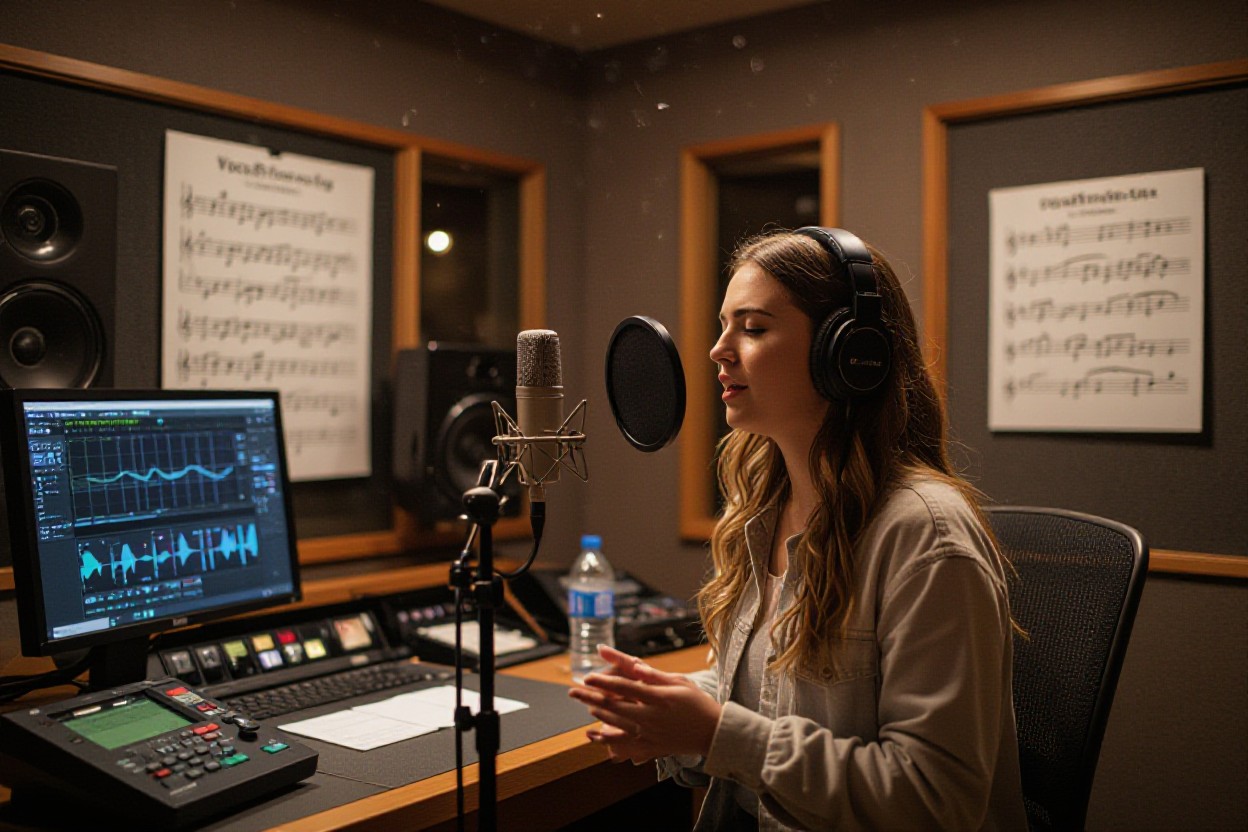
You should equip yourself with a few basics: a reliable tuner/metronome app, a simple keyboard or piano app for pitch reference, a portable recorder for tracking progress, and a low-latency microphone or headset for live feedback.
10–20 minute warm-ups work well for most singers, so use tools that let you repeat and record short loops. Also, keep hydration tools, a reusable water bottle, and a small humidifier—for consistent vocal fold condition when you rehearse in dry rooms.
Apps and Technology for Warm-up Guidance
Use apps like VocalizeU, SingSharp, Warm Me Up, and VoxTools to get guided routines, pitch tracking, and visual feedback; many offer 5–30 minute presets and interval training.
You can pair a phone with a Bluetooth speaker or a USB mic to your laptop for clearer monitoring, and run a DAW (Audacity or GarageBand) to loop scales and slow down passages. Track daily progress with built-in stats and export recordings for teacher review.
Recommended Literature for Further Reading
Consult titles such as Complete Vocal Technique (Cathrine Sadolin) for contemporary methods, The Structure of Singing (Richard Miller) for acoustics and pedagogy, and Set Your Voice Free (Roger Love) for practical performance exercises.
Each book gives you step-by-step drills, voice classification guidance, and warm-up routines you can adapt to 10–20 minute sessions.
If you want to apply those books, pick one science-focused text (Miller or Sundberg) to understand mechanics, one practical coach (Love or Stager) for daily drills, and a modern technique book (Sadolin) for genre-specific work.
Rotate 3–5 exercises from these sources across a week—vocal fry or lip trills for activation, sirens for range, and targeted resonance drills—to build measurable improvements in range, stamina, and clarity.
Summing up
From above, you should build a short, steady pre-singing routine that warms breath, eases tension, and wakes vocal folds. Start with gentle breathing, lip trills, and humming, then add range and articulation exercises.
Be consistent, listen to your body, and adjust pace for tired or tight days. A calm, focused warm-up helps your voice perform better and stay healthy.
FAQ
Q: What are simple steps for an effective pre-singing warm-up?
A: Start with good posture: stand tall with shoulders relaxed. Take several slow, deep breaths from your belly to steady your air. Do gentle physical loosening, like rolling your shoulders and neck stretches for a few minutes.
Move to lip trills or tongue trills to wake the voice without strain. Humming and sirens (sliding up and down your range) help connect breath and sound. Finish with short, easy scales that slowly increase in pitch and volume. Each part should feel relaxed, not forced.
Q: How long should I warm up before singing?
A: A quick warm-up can be 5–10 minutes if you only need to sing a short song. For practice sessions or performances, aim for 20–30 minutes, so your voice wakes up. Start very gently and build intensity slowly over time.
If you feel tension or tiredness, add a few more minutes of gentle humming and breath work before moving on. Hydrate with small sips of water during the warm-up.
Q: What are common mistakes to avoid during warm-ups?
A: Don’t push high notes too early or sing loudly right away. Avoid gripping the throat or tensing the jaw; if you feel strain, stop and go back to easier sounds. Skipping breath work and posture makes vocal control harder.
Singing on a dry throat or after shouting can cause fatigue, so drink water and rest if needed. If pain or hoarseness continues, pause and consult a teacher or doctor.